
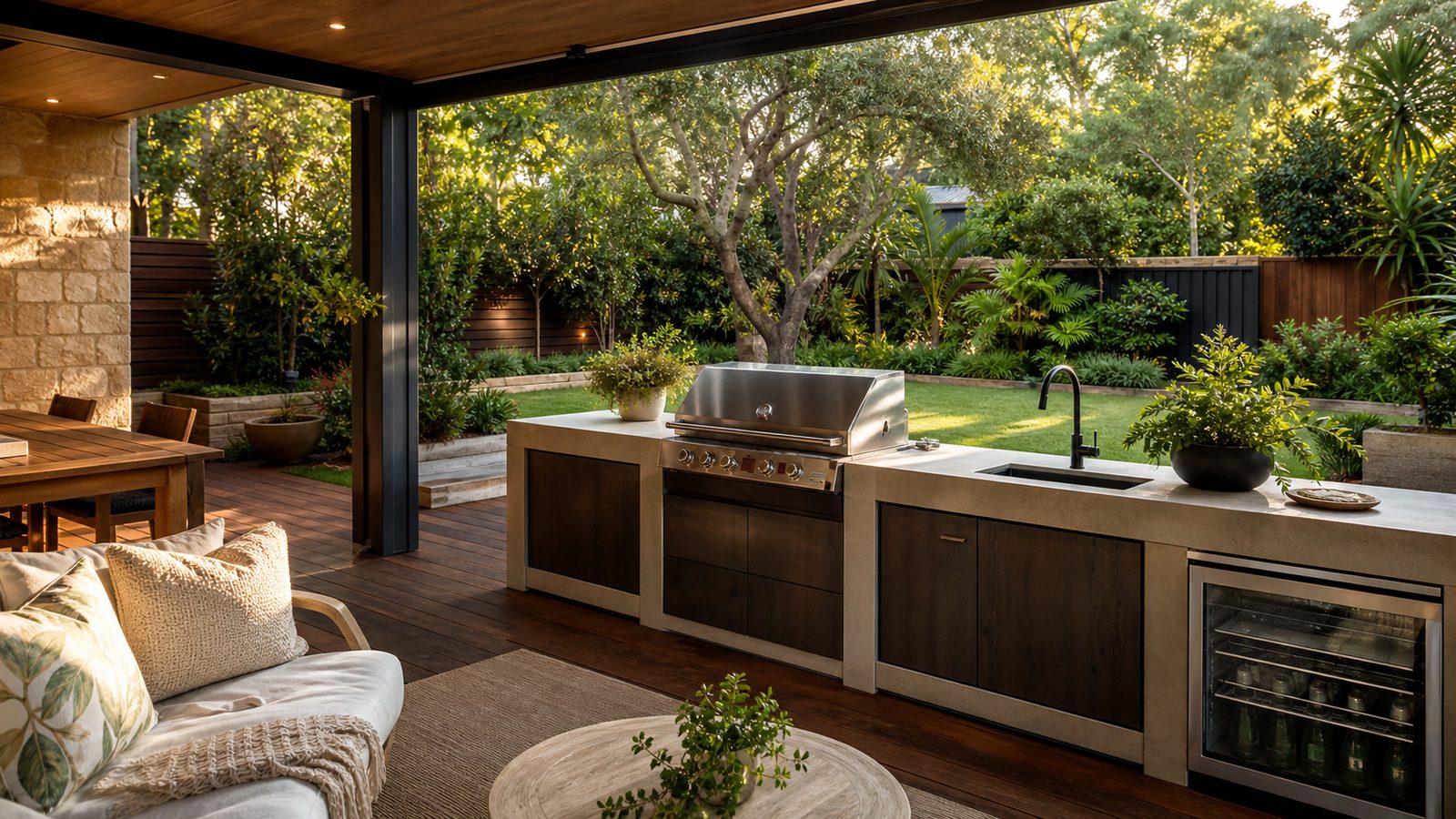
Decide what belongs in the outdoor fridge
An outdoor fridge is useful when it removes a real inconvenience, such as people repeatedly crossing the cooking area to collect drinks. Start by describing what you will put in it and when. A fridge used for sealed drinks during gatherings has a different brief from one expected to hold food continuously. Ask the supplier to confirm that the exact appliance is suitable for the intended contents and location. A glass door and stainless trim do not answer either question.
For a Cranbourne kitchen retrofit, consider where people stand while choosing a drink. The best-looking position on the cabinet drawing might put an open fridge door across the route between the BBQ and dining table. Sketch the door open with a person in front of it, then show the cook moving past with a tray. If those paths conflict, moving the drinks zone away from the cooking end may be more valuable than adding capacity.
Make a list of the containers you actually buy. Tall bottles, cans, a water jug and serving platters use shelves differently. Take the dimensions of the awkward items to the showroom and ask to see the internal arrangement. Advertised capacity is less useful than knowing whether your normal drinks fit without removing every second shelf. Decide which items can stay in the indoor fridge, so the outdoor cabinet is sized around a practical job rather than an imagined party.
Identify the appliance before designing the cabinet
Choose a specific model before the cabinet opening is finalised. Ask the supplier for the current installation instructions, external dimensions, door-opening requirements and permitted location. Keep the model code on the cabinet drawing. If a supplier proposes a substitute, repeat the compatibility check rather than accepting a product described only as the same size. Handles, hinges, feet and ventilation arrangements can differ even when two appliances look similar from the front.
Manufacturer support pages can provide a useful starting point. For example, BeefEater's appliance support page separates the installation guide, user manual and fact sheet. Obtain the equivalent documents for the appliance you are actually considering and ask the installer to use the installation information when detailing the cabinet. A sales sheet may help you compare appearance without containing everything needed to build the enclosure.
Check the product history before reusing or buying a used appliance. BeefEater's recall notice identifies affected BS28130 and BS28200 refrigerators by model and serial range, with instructions to switch off, unplug and contact Electrolux for a refund. Check your identification plate against the current notice; the model name alone is not the full test. Follow the recall instructions for an affected unit before considering cabinetry around it.
Draw the complete air path
Ask the installer to show where the selected fridge takes in air and where it releases heat. Then have the cabinetmaker mark the corresponding openings on the drawing. This conversation should use the appliance manual, not a general rule about leaving a small gap somewhere behind the unit. Ask whether the proposed installation is permitted as built-in, freestanding or another manufacturer-defined arrangement. The answer determines how the surrounding joinery can be detailed.
Check the air path after adding every visible finish. A decorative kickboard, side panel or benchtop overhang may sit where the appliance installer expected an opening. Have the drawing include those finishes rather than treating them as a later styling choice. If a grille is required, ask for the exact grille or opening to be specified and shown at its installed position. A cabinet that looks tidy with the ventilation concealed is useful only if the final arrangement remains suitable.
Consider what people will store nearby. A clear opening at handover may later become the easiest place to lean a chopping board, push a bag of charcoal or stack serving trays. Ask for storage compartments that make those habits less likely. Keep ventilation spaces visibly separate from storage, and record their purpose in the handover information. This is a design problem you can address before installation rather than a repeated reminder to clear clutter during every gathering.
Assess shelter, sun and neighbouring appliances
Describe the actual exposure at the proposed position. Photograph the roof edge, the open sides and the path of rain that sometimes reaches the cabinets. Ask the fridge supplier whether the product is suitable for that arrangement and what protection the instructions require. The word outdoor does not mean every exposed location is acceptable. A unit beneath a deep roof and one placed at the edge of an open patio can face very different conditions.
Record whether direct sun reaches the fridge door during the hours you use it. Ask how the manufacturer expects the appliance to be positioned relative to sunlight and ambient conditions. Do not assume a blind is an uncomplicated solution if the same area contains a BBQ. Any proposed screening belongs in the wider layout review described in our blinds and BBQ ventilation guide. Resolve the fridge's shelter needs without overlooking the cooking area.
Show the BBQ, pizza oven and any other heat-producing equipment beside the fridge on the same plan. Have the relevant installers determine separation and enclosure requirements from the selected products. If a tall dividing panel is proposed, check how it affects both appliance access and the air path. Ask who is responsible for that shared detail. The cabinetmaker should not have to invent a separation arrangement after both appliances have already been delivered.
Make the door and shelves work in the finished space
A fridge can slide into an opening and still be difficult to use. Ask the supplier how far the door must open for drawers or shelves to be removed, then test that movement against the adjacent cabinet, wall and benchtop. Include the handle, not just the door slab. At the end of a kitchen run, a side wall may be the limiting feature; in a corner, another cabinet handle might interfere first.
Compare hinge positions with the direction people approach. A door that opens toward the serving bench can make loading awkward even when it clears everything. Ask whether the model offers the hinge arrangement you need and whether changing it is supported by the manufacturer. Do not order on the assumption that every door can be reversed. Record the chosen configuration on the purchase order and have it checked against the cabinet plan before installation.
Look at the floor in front of the fridge too. A raised threshold, drain or rug can affect how comfortably someone stands while loading it. If the floor is being replaced, coordinate the finished level before finalising the opening height. Our alfresco flooring guide explains the related threshold and surface decisions. Also ask how the fridge will be withdrawn across that finished surface for service without damaging the floor or trapping the appliance beneath the benchtop.
Plan power and service access together
Ask the electrician and installer to agree a suitable power arrangement for the chosen product and location. Show where the supply will be accessible and how the appliance can be isolated for service. Energy Safe Victoria says electrical and gasfitting work must be left to qualified, licensed professionals. Treat the fridge purchase as an opportunity to have the actual outdoor supply assessed, rather than assuming the nearest existing outlet is suitable.
Access should not depend on dismantling the kitchen. Ask how a service person reaches the connection, removes any retaining detail and withdraws the appliance. If the cabinetry has a continuous plinth, establish which section can be removed and how it is identified. Keep decorative screws and removable panels accessible. A service path drawn during design is easier to preserve than one discovered after stone, splashbacks and side panels have enclosed the unit.
Discuss the ownership routine as well. If the fridge will be switched off between gatherings, ask the manufacturer how it should be cleaned, dried and left during storage. If it will run continuously, decide who checks it before filling it for an event. Keep the instruction manual with the model and serial information in a location you can retrieve without moving the appliance. These records help with service enquiries and make future recall checks straightforward.
Compare cabinet changes with appliance changes
When replacing a failed outdoor fridge, begin with the opening and the current service arrangement. Measure the visible width, height and depth, but ask the installer to verify the usable space and required allowances. Photograph the cabinet with the fridge in place and, when safely removed by the appropriate person, the enclosure behind it. An apparently matching replacement may need a different air path or door clearance. The decision is about the combination, not just the appliance.
Request two scopes where appropriate: retaining the cabinet with a compatible model, and altering the cabinet to suit the preferred model. Compare the work each includes, such as modifying a plinth, changing a side panel or arranging power access. This can reveal that a visually similar fridge is the simpler option, or that a modest cabinet alteration allows a better everyday arrangement. Avoid selecting a unit solely to reuse an opening whose original layout was inconvenient.
If the opening will remain empty temporarily, ask how the space will be left safe and protected while you decide. Do not turn a required ventilation void into permanent storage without understanding its role in the surrounding kitchen. Likewise, do not seal an opening simply because the old appliance has gone if nearby equipment relies on it. Have the contractor identify which cabinet details belong to the fridge and which serve the wider installation before making changes.
Check the finished installation with the people who use it
At handover, open the door fully, remove a shelf and show that the normal containers fit. Ask the installer to identify the ventilation openings, accessible power point and service-removal path. Confirm the installed model and hinge arrangement match the agreed schedule. If the appliance was substituted during supply, request the revised instructions and evidence that the cabinet design was checked against them. Keep that record with the invoice.
Walk through loading drinks while someone else stands at the BBQ and another person sits at the table. This is a practical way to check the layout you approved, without turning the first family gathering into a test. Raise awkward door collisions or inaccessible panels while the contractor can inspect them. If a decorative finish blocks an agreed opening, have the discrepancy resolved rather than treating the appearance as more important than the installation detail.
Finally, label the information you will need later: model, serial number, supplier, installation date and the location of the manuals. Do not bury the details in a long email thread that another household member cannot find. The checklist below helps you collect the same information before the job. A well-considered fridge installation should make drinks easier to reach while remaining accessible for cleaning, service and eventual replacement.